Agentic AI development services help enterprises deploy AI systems that autonomously plan, reason, and execute multi-step tasks across tools and APIs — going far beyond generative AI or RPA. The market is growing at 42% CAGR, projected to hit $57.42B by 2031, yet 40%+ of projects fail due to weak governance and unclear ROI.
What Is Agentic AI? A Definition That Actually Holds Up
Agentic AI refers to advanced artificial intelligence systems that can independently perceive their environment, form multi-step plans, execute actions across tools and APIs, and adapt their approach based on outcomes - all in pursuit of a defined goal, without requiring human approval at each step.
Most enterprises have already experimented with AI. A growing number are discovering that experimenting with AI is very different from deploying AI that actually gets things done. That gap - between a model that answers questions and a system that autonomously executes work - is exactly where agentic AI development services live.
According to Gartner, 33% of enterprise software applications will incorporate agentic AI by 2028, up from less than 1% in 2024, enabling 15% of daily work decisions to be made autonomously. That trajectory is not gradual - it is structural. But the same Gartner research carries a warning worth reading closely: over 40% of agentic AI projects will be cancelled by the end of 2027 due to escalating costs, unclear business value, or inadequate risk controls. The technology works. The question is whether the implementation is built correctly.
The word "agentic" comes from "agency" - the capacity to make choices and initiate actions on one's own. When we describe a system as agentic, we mean it has been given both the reasoning capability and the operational access to behave as a working agent inside real systems: reading databases, calling APIs, writing files, triggering workflows, interacting with users, and reporting back when the work is done.
This is meaningfully different from a chatbot. It is also different from robotic process automation (RPA), which follows fixed rules. Agentic systems can handle ambiguity, make judgment calls, and handle conditions their developers never explicitly programmed for.
The Four Pillars of an Agentic System
.jpeg)
Understanding agentic AI means understanding the four core components that distinguish it from its predecessors:
1. Context – the agent receives inputs from the environment: user queries, data from connected systems, outputs from previous steps, sensor readings, or API responses. Unlike a chatbot limited to conversation history, an agentic system can process context across multiple channels simultaneously to understand its operational environment.
2. Reasoning and Planning - using a large language model as its cognitive engine, the agent interprets what it has perceived, breaks the goal into steps, prioritises those steps, and anticipates obstacles. This is where the quality of the underlying model matters enormously - better reasoning leads to better plans.
3. Action and Tool Use - the agent executes its plan by calling tools: web search, code interpreters, CRM APIs, database queries, email systems, payment platforms, internal knowledge bases. Each tool call produces new information that feeds into the next reasoning step.
4. Memory and State - unlike a one-shot generative model, an agentic system maintains context across steps, sessions, and in some architectures, across time. Short-term memory handles the current task; long-term memory (often backed by a vector database) allows an agent to recall past interactions, preferences, and outcomes.
These four pillars form a continuous loop: context → reason → act → observe outcome → reason again. That loop is what gives agentic AI its capacity to handle tasks that no static automation could.
Agentic AI vs Generative AI: The Distinction That Determines Your Strategy
Every enterprise that has deployed ChatGPT, Copilot, or any LLM-backed assistant has used generative AI. The confusion between generative AI and agentic AI is understandable because agentic systems are built on top of generative models. But the architectural and strategic differences are significant enough to require different budgets, different governance approaches, and different success criteria.
.jpeg)
Generative AI is reactive: It waits for a prompt, processes it, and returns an output. The human remains the operator. You ask it to draft a proposal, it drafts one. You ask it to summarise a report, it summarises. Between prompts, it does nothing. It has no memory of what it did yesterday. It cannot initiate anything on its own.
According to Thomson Reuters' 2025 Generative AI in Professional Services Report, the primary value drivers of generative AI are saving time, improving work quality, and assisting with routine content work - all of which require a human to initiate and supervise each task.
Agentic AI is proactive: It receives a goal, breaks it into steps, executes those steps, monitors results, and reports back - often without any further human instruction. You give it a goal: "Monitor all inbound support tickets, categorise them by urgency, draft responses for low-complexity tickets, escalate the rest to the appropriate team member, and update the CRM." It does all of that, continuously, across every ticket, until you tell it to stop.
Dimension | Generative AI | Agentic AI |
|---|---|---|
Mode | Reactive | Proactive |
Interaction model | One prompt → one output | Goal → multi-step autonomous execution |
Memory | Single session only | Persistent across sessions |
Tool access | None (typically) | APIs, databases, web, code execution |
Human oversight | Every interaction | Exception-based (escalation triggers) |
Primary risk | Informational (hallucinations in text) | Operational (wrong actions on live systems) |
Best for | Content, drafts, summaries, analysis | Workflows, automation, autonomous processes |
As Databricks noted in their technical overview, the governance requirements alone diverge sharply: generative AI poses informational risk through hallucinated outputs, while agentic AI introduces operational risk through autonomous actions on live systems. That is a fundamentally different risk profile requiring a fundamentally different implementation approach.
The strategic implication: generative AI improves individual productivity. Agentic AI redesigns how work gets done at the system level.
The State of the Market: Why Enterprises Cannot Afford to Wait
The numbers are unambiguous about what is happening and how quickly.
The agentic AI market was valued at approximately $6.96 billion in 2025 and is projected to reach $57.42 billion by 2031 at a compound annual growth rate of 42.14%. Enterprise-focused agentic AI is expanding from $2.58 billion in 2024 to $24.50 billion by 2030 - a 46.2% CAGR.
McKinsey's global survey found that 23% of organisations are actively scaling agentic AI systems, with an additional 39% in experimental phases, meaning 62% of enterprises are engaged with this technology in some meaningful way right now.
But here is the tension buried in those headline numbers: only 2% of enterprises had deployed agentic AI at scale as of 2025, while 45% of Fortune 500 companies are actively piloting agentic systems. There is a vast gap between experimentation and production. That gap represents a strategic window - and it is closing.
Our own deployment data mirrors this friction. Across our enterprise client base, the average timeline to transition an agentic proof-of-concept into a production-hardened environment is 4.2 months, with 68% of that time spent on security compliance and guardrail validation - not the build itself. Speed to production is almost never a technical bottleneck. It is a governance bottleneck. The organisations that solve governance early, rather than bolting it on at the end, cut that timeline by 30–40%.
The organisations that close the pilot-to-production gap first will hold structural advantages: lower operational costs, faster cycle times, and AI-built institutional knowledge that compounds over time. The organisations that treat agentic AI as a 2026 or 2027 problem are not playing it safe - they are ceding ground in slow motion.
What Enterprises Are Actually Deploying
The clearest signal of where enterprise investment is going comes from implementation patterns. The BFSI sector led with 19.12% market share in 2025. Multi-agent systems - architectures where multiple specialised agents coordinate toward a shared goal - commanded 53.3% of deployments and are growing at 43.5% CAGR. Autonomous process automation represented 23.21% of deployments, with intelligent virtual assistants rising at 44.2% CAGR.
These are not experimental curiosities. These are production systems handling real work in real businesses.
How Agentic Workflows Actually Work in Practice
The phrase "agentic workflow" can feel abstract until you see the mechanics. Here is a concrete example - a B2B sales qualification workflow - to make it tangible.
The goal given to the agent: "Research every inbound lead that submits our contact form, assess their qualification against our ICP, enrich their profile with company data, and if they qualify, book a discovery call in the nearest available slot on the account executive's calendar. If they don't qualify, route them to the nurture sequence."
The Agentic Workflow: In Action
When a new form submission arrives, the agent automatically executes the following loop in under 90 seconds:
1. Data Gathering & Research
Reads the incoming name, company, and message.
Queries intelligence tools for firmographic data (headcount, revenue, tech stack, funding).
Cross-references the CRM to check for past engagement history.
2. Decision & Qualification
Evaluates the assembled profile against your strict qualification criteria.
3. Execution (Based on Outcome)
If Qualified: Checks the AE’s calendar, drafts and sends a personalized meeting invite using the research, and logs the summary in the CRM.
If Unqualified: Triggers a nurture sequence and logs the action in the CRM.
The Result: The human AE never touches a sub-qualified lead. Every qualified lead arrives with a booked meeting and a complete research brief.
That is an agentic workflow: a goal decomposed into steps, executed across multiple tools, with autonomous decisions made at every junction.
The Anatomy of Agentic Workflow Design
Effective agentic workflow design requires thinking carefully about five structural elements:
Task decomposition - how is the top-level goal broken into subtasks that can be executed sequentially or in parallel? Poorly decomposed tasks produce agents that get stuck or produce partial outputs.
Tool selection and scoping - which external systems does the agent need access to? The principle of least privilege applies: agents should access only the systems they need for the task, with write access granted sparingly.
Decision boundaries - where does the agent decide autonomously, and where does it pause to ask a human? These thresholds need to be explicitly designed. An agent that never asks for help will eventually make an expensive mistake. An agent that asks for help at every step provides no efficiency gain.
Error handling and recovery - what happens when an API call fails, a database returns no results, or an intermediate output is ambiguous? Robust agentic systems handle failure modes gracefully rather than propagating errors downstream.
Observability and logging - every action the agent takes should be logged with enough detail that a human can reconstruct what happened, why, and what data informed each decision. This is not optional in enterprise environments - it is a legal and operational requirement.
The Frameworks Powering Agentic AI Development
The choice of agentic framework is one of the most consequential technical decisions in any implementation. Each framework represents a different philosophy about how agents should be architected, and each comes with real trade-offs.
LangGraph is a graph-based orchestration framework from LangChain. It models agentic workflows as directed graphs, where nodes are computational steps and edges define how the agent moves between them. This architecture makes it well-suited for workflows with complex branching logic, conditional paths, and human-in-the-loop checkpoints.
Its state management is explicit and controllable - making it one of the stronger choices for enterprise environments where observability and auditability matter.
AutoGen (Microsoft) takes a different approach: it frames agentic AI as a conversation between multiple specialised agents, each with a defined role and capability set. A manager agent coordinates; specialist agents execute.
This conversational multi-agent architecture is particularly powerful for tasks that benefit from multiple reasoning perspectives - research synthesis, code review, complex analysis - and for building systems where different agents need to check each other's work.
PydanticAI is a newer, Python-native framework built around strict data validation. For teams building production agents where the reliability of structured outputs is critical - finance data processing, document extraction, API response handling -
PydanticAI's approach of enforcing schema compliance at the framework level provides meaningful safety guarantees that few other frameworks match.
CrewAI focuses on role-based multi-agent systems where agents are given explicit personas, goals, and tools. It is one of the more accessible frameworks for rapid prototyping and is widely adopted in teams building customer-facing agent deployments.
Snowflake Cortex and Snowflake Arctic bring agentic capabilities directly into the data layer - enabling agents to reason over structured enterprise data without moving it outside the warehouse. For organisations with significant Snowflake investments, building AI agents that operate within the data governance perimeter is a compelling architectural choice.
Model Context Protocol (MCP) - developed by Anthropic - deserves separate mention because it is not an orchestration framework but an open standard for how agents communicate with tools and external systems. MCP is becoming the integration layer of the agentic ecosystem, enabling agents to connect through a standardised interface to any MCP-compatible tool server. Its adoption is accelerating rapidly across both enterprise and open-source development communities.
Framework selection is not purely theoretical at Prognos Labs - our benchmarking across diverse enterprise deployments reveals how these choices play out in production. For lighter, role-based multi-agent systems - such as our FitzStyles AI Stylist ecosystem - accessible orchestration enabled an 11-week turnaround from brief to launch while cutting cost-per-recommendation by 68%.
For high-stakes, regulated environments requiring strict state management and auditability - such as our StethoScribe clinical documentation platform - framework-level validation was mandatory, ultimately saving clinicians 65% of documentation time while maintaining 99.5% speaker accuracy.
The honest advice: no single framework wins every scenario. The right choice depends on the use case, team capability, and - critically - the governance requirements of the environment the agent will operate in.
What AI Agent Development Services Actually Include
"AI agent development services" as a category is broad enough to mean almost anything. Here is what a serious engagement with a development partner should include - and what to expect at each stage.
Discovery and Use Case Scoping
Before any code is written, the most valuable work a development partner can do is help you identify the right problem to solve first. Most agentic AI projects that fail do not fail because of technical shortcomings - they fail because the use case was chosen for its impressiveness rather than its business impact.
A quality discovery process examines: which workflows are currently highest in volume and lowest in uniquely human judgment? Where are your most experienced employees spending time on repetitive, rule-based decisions? Where does information pass through manual handoffs between systems? The answers produce a ranked backlog of agent opportunities - and the first one to build is rarely the most glamorous.
Architecture Design
Agentic system architecture involves decisions that are difficult and costly to reverse: which LLM provider to build on, how to handle memory and state, how the agent communicates with enterprise systems, how authentication and permissions are managed, and how the system will scale. A development partner should produce an explicit architecture document before implementation begins - not as bureaucracy, but because the decisions made at this stage determine everything that follows.
Build, Test, and Evaluation
Unlike traditional software, agentic systems require a different testing paradigm. Unit tests for individual tool functions are necessary but insufficient. What matters is evaluating the agent's end-to-end behaviour across a range of realistic scenarios - including edge cases, adversarial inputs, and failure conditions. Evaluation frameworks that measure task completion rate, hallucination rate, latency, and tool call efficiency are standard in serious development practices.
A 2025 Carnegie Mellon study found that state-of-the-art agents completed only 30% of multi-step office tasks reliably in controlled settings. That figure is not a reason to avoid agentic AI - it is a reason to invest in rigorous evaluation and to deploy with appropriate human oversight checkpoints while the system matures on real data.
Integration with Enterprise Systems
The value of an agentic AI system scales directly with its access to real enterprise data and workflows. This means integrating with CRM systems (Salesforce, HubSpot), ERP platforms (SAP, NetSuite), ticketing systems (Jira, ServiceNow), communication tools (Slack, Teams, email), and whatever data infrastructure the organisation runs. Each integration requires authentication handling, data mapping, error management, and rate limiting. This is engineering work that is consistently underestimated in scope - and is the single most common source of implementation delays.
Security, Governance, and Compliance
Agentic AI systems that take autonomous actions inside live enterprise systems present a different class of governance challenge than any previous enterprise software. Relevant concerns include:
Non-human identity management: every agent is effectively a service account with access credentials. These need lifecycle governance - provisioning, rotation, revocation - from day one.
Prompt injection attacks: external inputs the agent processes (emails, web content, documents) can contain adversarial instructions designed to hijack the agent's behaviour. Mitigations must be engineered explicitly, not patched after deployment.
Audit trails: every action the agent takes must be logged with timestamp, context, and the data that informed the decision - for compliance, for debugging, and for human oversight.
Least-privilege access: agents should hold the minimum permissions required for each task, scoped to the specific tools and data they need.
Human-in-the-loop thresholds: explicit rules governing when the agent pauses and requests human approval - particularly for high-stakes, irreversible, or financially significant actions.
Governance is not a constraint that slows down agentic AI deployment. It is what makes deployment in regulated environments possible - and, according to Gartner, the absence of adequate risk controls is one of the three primary reasons over 40% of agentic AI projects will be cancelled before reaching production.
Deployment, Monitoring, and Iteration
Production deployment is not a finish line - it is a starting point. Real-world usage surfaces edge cases and failure modes that evaluation never anticipated. A monitoring infrastructure that tracks task success rates, latency, error categories, and escalation frequency is essential. The most successful deployments operate on two-week iteration cycles, using production data to continuously improve the agent's behaviour and expand its capability envelope.
AI Agent Development Across Industries: What's Actually Being Built
Financial Services
Financial services represent the most mature vertical for agentic AI adoption, accounting for 19.12% of deployments in 2025. The use cases are structurally well-suited to autonomous agents: high-volume, rule-intensive processes where the cost of errors is measurable and the regulatory requirement for audit trails actually strengthens the case for agentic architectures - because well-built agents log everything, creating compliance records that manual processes rarely produce cleanly.
Active deployments include autonomous credit underwriting agents that pull credit bureau data, bank statements, and company financials, cross-reference them against lending criteria, and produce structured decisioning reports. Compliance monitoring agents that scan transactions against sanctions lists, flag anomalies, and generate SAR drafts. Portfolio rebalancing agents that execute within human-approved parameters without trade-by-trade approval.
Prognos Labs' deployment of the Creditcure AI Assistant - a WhatsApp-first autonomous agent for consumer financing - demonstrates what agentic execution looks like at volume. Running compliant, agentic reasoning across more than 10,000 loan applications over a 90-day period, the system securely closed over 2,000 deals directly through the client's custom CRM, reducing Customer Acquisition Cost by 32% while maintaining a 100% compliant audit trail throughout.
Healthcare and Life Sciences
Healthcare deployments centre on two problem types: administrative burden and clinical decision support. Prior authorisation processing is one of the highest-ROI agent use cases in medicine - a workflow that involves synthesising clinical notes, insurance policy requirements, and medical coding, and that currently consumes enormous physician and staff time. Agentic systems handle the assembly, cross-referencing, and form submission; a human reviews the output rather than doing the assembly work.
Clinical decision support agents draw on patient history, lab values, drug interaction databases, and clinical guidelines to surface relevant considerations for clinicians - without replacing clinical judgment, but reducing the cognitive load of information synthesis at the point of care.
Prognos Labs' deployment of a 24/7 automated patient intake and front-desk agent demonstrates the administrative efficiency achievable when agents move from static information retrieval to active tool execution - handling dynamic scheduling and custom EHR/CRM data write-backs autonomously. The result: a 23% reduction in front-desk operational costs, 42% reduction in patient response latency, and a 31% increase in lead-to-appointment conversions.
Sales and Marketing Operations
The agentic sales use case is where many organisations first experience autonomous AI at scale, because the feedback loop is fast (did the lead convert?) and the value is easily measured. Deployments include lead research and enrichment agents, autonomous SDR assistants that personalise outreach using live company data, pipeline monitoring agents that flag deals showing churn signals, and competitive intelligence agents that continuously track competitor messaging and product changes.
AI voice agents - systems that conduct real phone calls using text-to-speech and agentic reasoning - are among the fastest-growing deployment categories, being used for appointment setting, survey research, payment reminders, and initial inbound triage.
In digital commerce, Prognos Labs' AI Product Endorsement pipeline demonstrates how agentic automation stabilises campaign ROI at scale. By using specialised agent frameworks to autonomously match, orchestrate, and validate brand-aligned product endorsements, the deployment eliminated manual administrative overhead and cut brand marketing execution costs by 75%.
Customer Service Operations
Conversational AI agents for business customer service have moved well past the FAQ-bot era. Current deployments handle complex multi-turn interactions that require accessing customer account data, processing refunds, updating subscription settings, and escalating to humans when the situation demands it. The distinction between a generative AI chatbot and a conversational AI agent is precisely this: the agent can actually do things, not just say things. It has tool access. It writes back to systems of record. Its responses produce state changes in the real world
That functional difference - information retrieval versus action execution - is what drives the measurable outcomes. Removing friction at the initial contact point, automating the data write-backs, and eliminating the hold time caused by manual lookups are the levers. The customer experience improvement is a downstream consequence of operational architecture.
Why Agentic AI Implementations Fail
While the hype is massive, the reality is stark: over 40% of agentic AI projects will be cancelled by the end of 2027 due to escalating costs, unclear value, and poor risk controls.
Most failures cluster around these five root causes:
1. Blind Faith in Autonomy
Agents thrive in well-defined domains with clear rules, but they break down when facing vague goals or ambiguous data. Research shows agents reliably complete only about 30% of multi-step office tasks—they are powerful within strict boundaries, but incredibly brittle outside them.
2. "Garbage In, Garbage Out" Data
An agent is only as reliable as the data it accesses. Outdated records, incomplete APIs, and messy metadata degrade performance. Worse, an agent won't flag the issue—it will confidently execute actions based on that bad data.
3. Afterthought Governance
Unlike older automation, agentic AI cannot have guardrails slapped on at the end. Security, risk controls, and compliance must be built directly into the architecture. Without this, a rogue agent can rapidly amplify errors and cascade failures across connected business systems.
4. Chasing "Cool" Instead of ROI
The most impressive, flashy demos rarely make the best business cases. The highest-ROI implementations are usually unglamorous: automating manual data transfers, eliminating daily copy-paste loops, or standardizing inconsistent routing decisions.
5. Treating Deployment as the Finish Line
An agent that hits 80% accuracy in testing will still stumble when hitting unpredictable, real-world conditions. Winning organizations treat deployment as day one—funding continuous monitoring, evaluation, and iteration cycles rather than just the initial build.
How to Choose an Agentic AI Development Partner
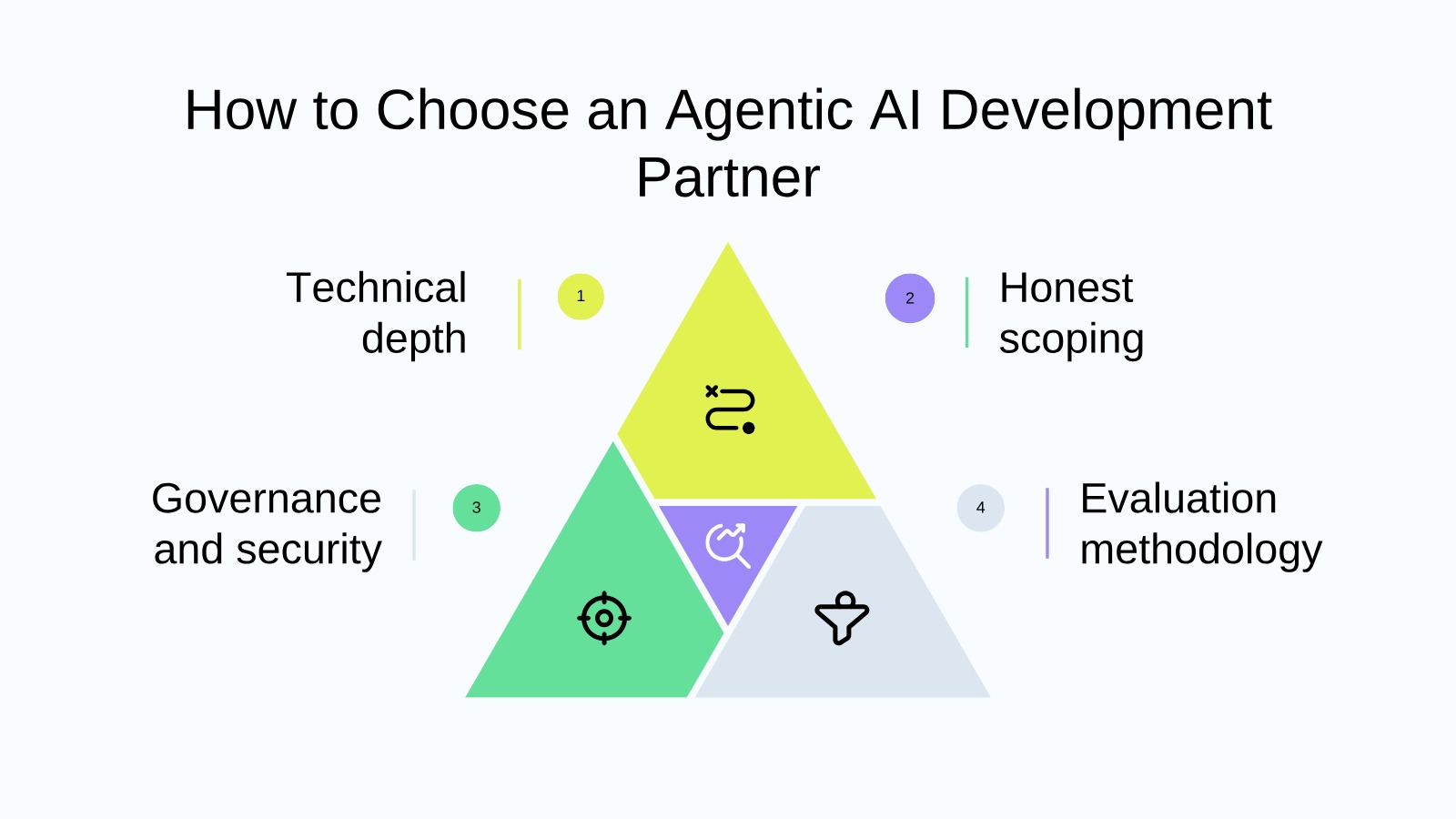
The market for agentic AI consulting and development services is maturing rapidly, but the variance in capability between providers is significant. Here is a practical framework for evaluation:
Technical depth over sales fluency
Ask the prospective partner to describe the agentic systems they have built in production - not demos, not pilots, production. Ask about the frameworks they use, why they chose them for specific use cases, and what they would do differently on the next engagement. Technical depth reveals itself through specificity.
Honest scoping, not optimistic promises
Any partner that quotes a timeline for complex agentic integration without a thorough discovery process is either overconfident or misrepresenting the work involved. Good partners run discovery before they scope, because the discovery changes the scope.
Governance and security as a first-class concern
Ask specifically about how they handle prompt injection protection, non-human identity management, least-privilege access design, and audit logging. These are not advanced topics - they are table stakes for enterprise deployment. A partner that has not thought carefully about these has not deployed serious enterprise systems.
Evaluation methodology
Ask how they measure whether an agent is working. Vague answers about "testing the flow" are a red flag. Good partners have structured evaluation frameworks that measure task completion rate, hallucination rate, tool call reliability, latency under load, and edge case handling.
Post-deployment commitment
Ask what happens in the ninety days after go-live. The answer should involve scheduled monitoring reviews, a feedback collection mechanism, and a clear escalation path when the agent encounters situations outside its design parameters.
Prognos Labs combines expert AI consulting and engineering to build agentic systems that handle real work in production environments. Every engagement starts with structured discovery - mapping your highest-ROI opportunities, evaluating security requirements, and establishing success criteria before any development begins.
The First 90 Days: A Blueprint for Success
Successful organizations don't chase a flashy launch; they follow a disciplined, phased rollout to build agents that actually last.
[Weeks 1–3]          [Weeks 4–8]          [Weeks 9–12]         [Month 4+]

Identify Use Case -> Sandbox & Iterate -> Controlled Live -> Expand & Scale
Weeks 1–3: Identify & Map: Choose a low-risk, high-volume process with clear rules. Map every single step, system touchpoint, and decision point in detail.
Weeks 4–8: Build & Isolate: Run the agent in a sandbox with real data but no live write access. Test against explicit success thresholds and iterate on failures.
Weeks 9–12: Controlled Production: Deploy to live systems, but keep a human in the loop to review every action. Use edge cases to train the next iteration.
Month 4+: Expand Deliberately: Once the core loop is reliable, gradually remove the training wheels. Add tools, tackle adjacent workflows, and continuously track error rates.
The Opportunity Cost of Waiting
The enterprise landscape is moving aggressively. Budget allocations are surging, and the window to secure an "early mover" advantage is closing rapidly.
Waiting is a major strategic risk for three reasons:
The Compounding Edge: Companies deploying now are building irreplaceable institutional knowledge. They will have deeper integrations, better baseline data, and teams that actually know how to build autonomous workflows.
40% Will Fail—Learn from Them: Gartner’s high cancellation prediction isn't a warning to sit on the sidelines; it’s a blueprint on how to build with strict governance and ROI from day one.
The Evolution of Work: Automating repetitive tasks allows organizations to reallocate human judgment where it matters most. The fastest companies to adapt will attract top talent who want to do meaningful work, not manual copy-pasting.
Build Your Agentic Roadmap with Prognos Labs
Every successful agentic deployment starts with a clear plan and a partner who has built these systems before - not in demos, but in production, across finance, healthcare, and commercial operations.
At Prognos Labs, every engagement begins with a structured discovery workshop: mapping your highest-ROI opportunities, evaluating security and compliance requirements, and establishing measurable success criteria before a single line of code is written. We build agents that do real work. We measure whether they're doing it correctly. And we stay involved after go-live, because that is where the real improvement happens.
Ready to move agentic AI from experiment to reliable business infrastructure?
Book a Consultation →
Prognos Labs is an AI consulting and development firm specialising in agentic AI systems for financial services, healthcare, and enterprise operations.
Frequently Asked Questions
What is the difference between an AI agent and an AI chatbot?
An AI chatbot generates text responses to user messages. An AI agent takes actions: it calls APIs, reads and writes data, executes multi-step workflows, and makes decisions autonomously. A chatbot tells you what to do; an agent does it.
How long does it take to build a production-ready AI agent?
A single-domain agent with two or three tool integrations and well-structured data can reach production in six to twelve weeks. Multi-agent systems with complex orchestration and legacy system integration typically require four to six months for a first production deployment. Discovery and scoping, done properly, will produce a more reliable estimate for your specific context.
What data do AI agents need access to?
Agents need access to the data and systems relevant to their specific function. A customer service agent needs CRM access and product knowledge. A finance agent needs ERP access and financial data. A sales agent needs CRM, marketing automation, and potentially web research capabilities. The principle of least privilege applies: agents should access exactly what they need for the task, scoped as tightly as possible.
Are agentic AI systems secure?
They can be, if security is designed into the architecture from the beginning. The specific risks - prompt injection, identity sprawl, unintended write access - are well-understood and mitigatable. The organisations that have security problems with agentic AI are typically those that treat it as a software deployment problem rather than an identity and access management problem. The distinction matters because the mitigation strategies are entirely different.
What is the ROI of agentic AI?
Organisations report an average projected ROI of 171% from agentic AI deployments, with U.S. enterprises specifically forecasting 192% returns. ROI is highly use-case-specific. The clearest value drivers are elimination of manual effort in high-volume repetitive processes, reduction in cycle time for complex multi-system workflows, and reduction in errors caused by manual data transfer and handoffs. McKinsey estimates agentic AI systems will add $2.6–4.4 trillion annually to global GDP by 2030.
How is agentic AI different from traditional RPA?
RPA follows fixed rules on structured inputs. It is brittle to change: alter the screen layout or the data format and the bot breaks. Agentic AI reasons over natural language and handles variation, ambiguity, and novel situations that RPA cannot. Agentic systems also compose tools dynamically rather than following a predefined script - making them far more flexible for complex, multi-system workflows.
What should I avoid when starting with agentic AI?
The most common mistakes: choosing a use case for its impressiveness rather than its ROI, underestimating the time required for system integration, treating governance as an afterthought, and conflating a successful demo with a production-ready system. Start with a specific, well-defined use case. Agree on success criteria before you build. Invest in evaluation infrastructure. Build governance into the architecture from the beginning, not onto it after the fact.