StethoScribe: AI Medical Scribe Platform
Product Overview
StethoScribe is a voice-first AI platform designed to automate clinical documentation in both outpatient and inpatient settings. The founding team brought deep domain expertise in clinical workflows but needed an experienced development and AI engineering partner to bring their product vision to production.
Business Challenge
The clinical documentation crisis is well-documented: physicians in outpatient and inpatient settings spend an average of 2–3 hours per day writing up notes, prescriptions, referral letters, discharge summaries, and administrative records. This overhead displaces patient-facing time and is a primary driver of physician burnout across health systems.
"By the time I finish writing up my last patient’s notes it’s past 7pm. I started at 8am. The consultation took 12 minutes — the note took 25."
— General Practitioner, Urban Primary Care Clinic
StethoScribe approached us with a clear hypothesis: ambient AI could close this gap. But the client faced several compounding challenges that made this harder than simply deploying an off-the-shelf speech-to-text tool:
• Accuracy requirements are unforgiving — clinical errors carry direct patient safety risk, making hallucination and omission rates critical constraints, not product preferences.
• Multi-speaker environments are complex — consultations involve overlapping speakers, background noise, accents, and rapid topic-switching that degrade general-purpose transcription models.
• Medical terminology recall is specialised — standard LLMs exhibit a significant drop-off in retaining clinical entities (drug names, diagnoses, dosage information) as text passes through pipeline stages.
• Regulatory and compliance demands are non-negotiable — any system handling patient data must meet strict data handling, access control, and auditability standards.
• Clinician trust is fragile — adoption hinges on physicians feeling confident that AI outputs are a starting point they can verify, not a black box they must accept.
Our Solution
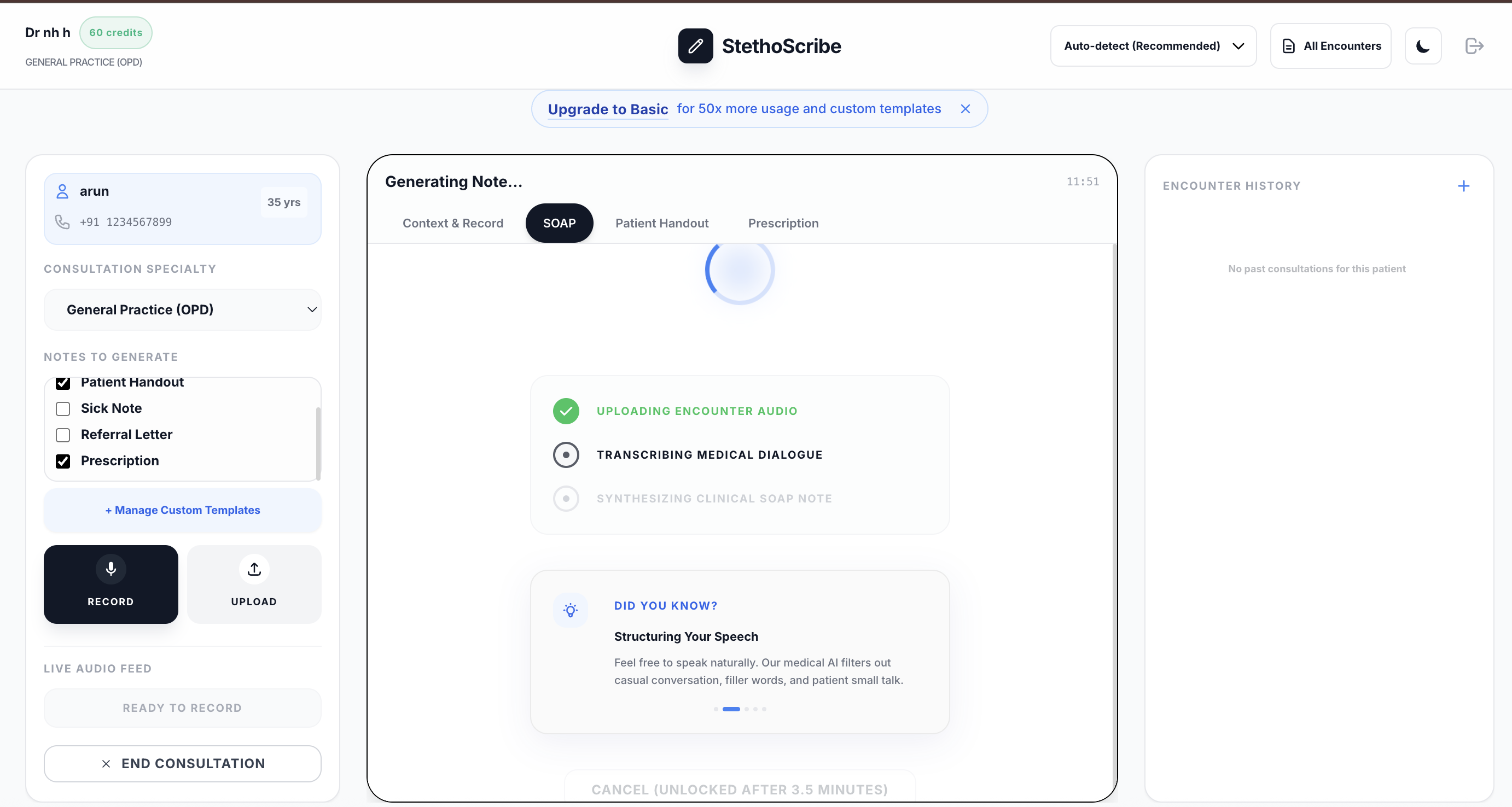
We designed and delivered StethoScribe as an end-to-end ambient AI platform — from audio capture through to clinic-ready, structured clinical documents. Our solution is built around five core stages of a consultation-to-document pipeline:
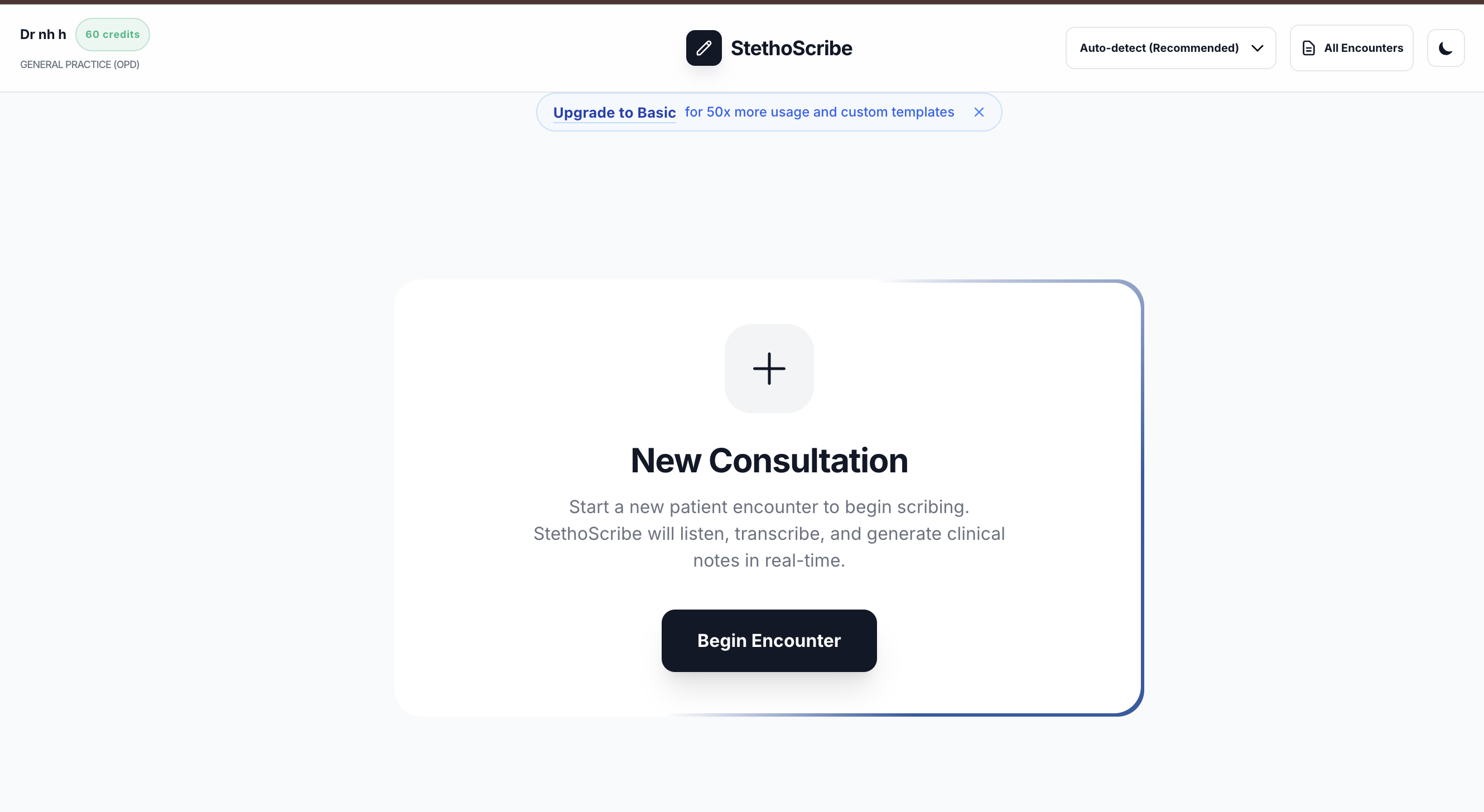
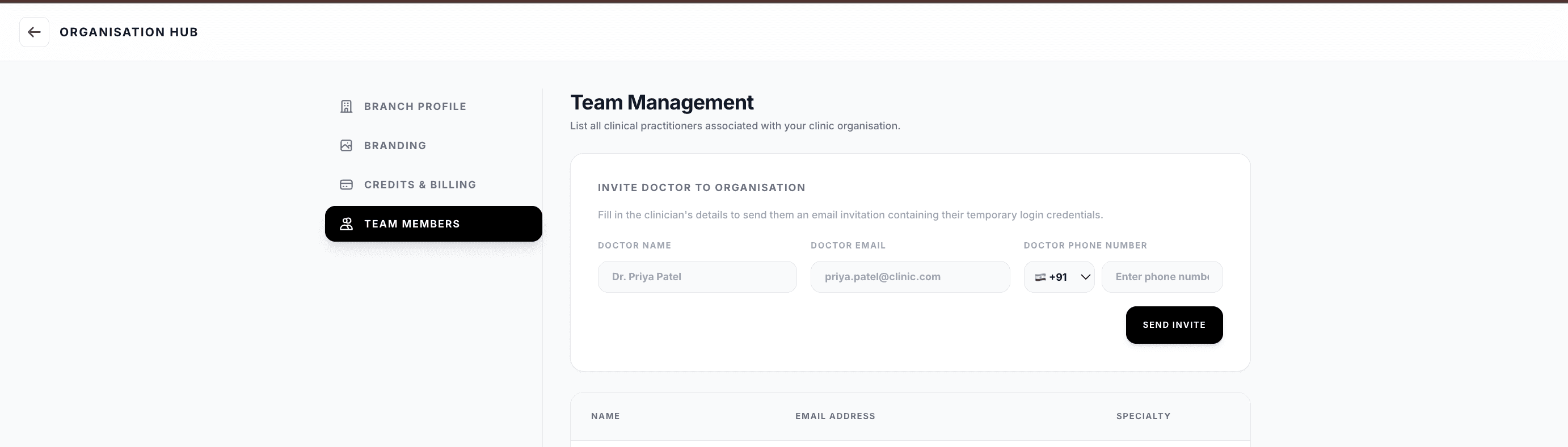
Stage 1 — Secure Clinician Authentication
We implemented SSO with multi-factor authentication and role-based access controls, ensuring only authorised clinicians can initiate patient sessions. The system is architected to allow integration with existing hospital identity providers without requiring data migration.
Stage 2 — Real-Time Ambient Audio Capture & Transcription
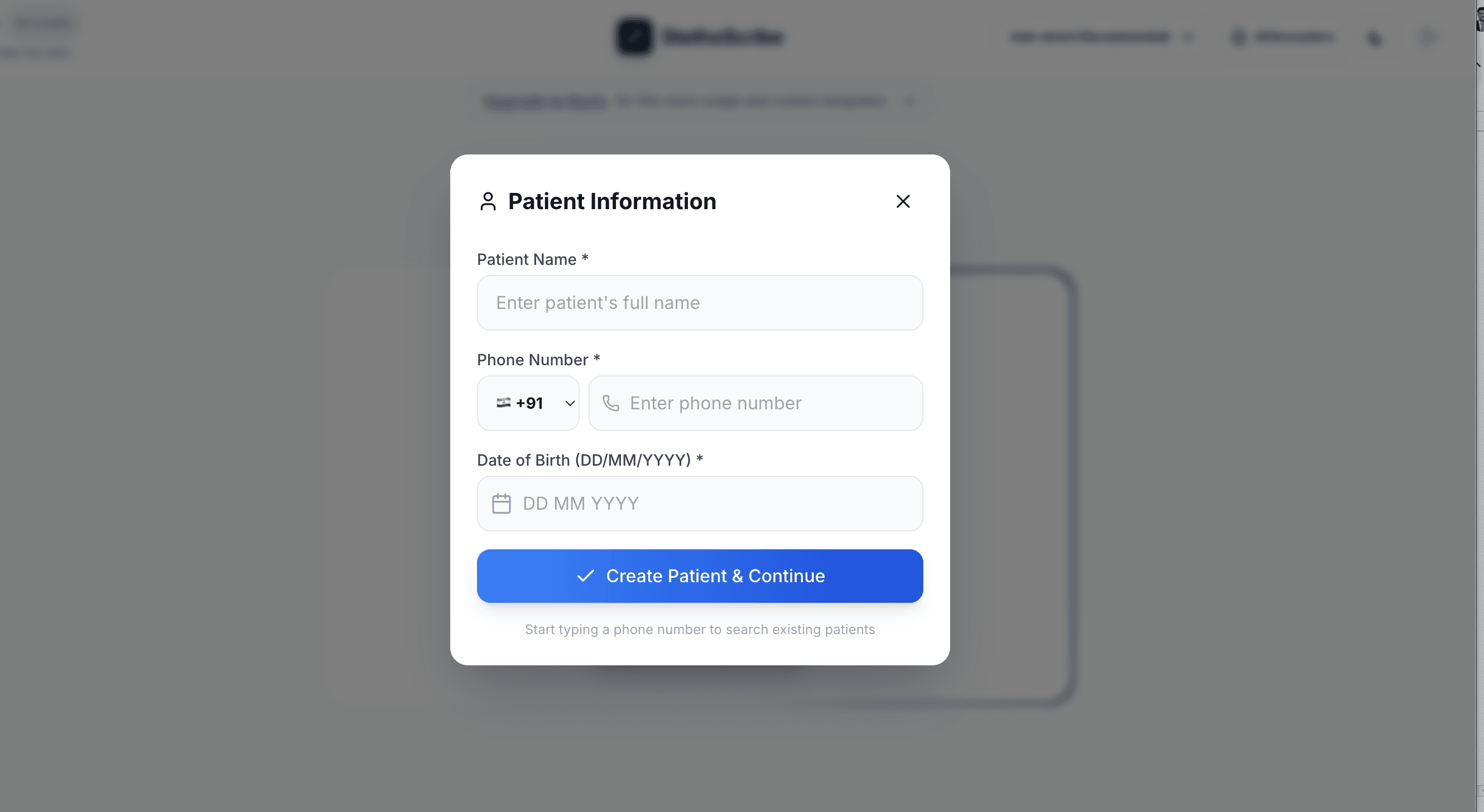
An ambient microphone captures the consultation passively. Our speech processing pipeline, delivers a live speaker-diarised transcript at sub-3-second latency — distinguishing physician dialogue from patient dialogue with a turn-level accuracy of 99.5%.It also includes a feature to upload audio recording supporting multiple audio formats.
Stage 3 — AI Clinical Structuring
At the core of the platform sits a medically fine-tuned large language model with RLHF (Reinforcement Learning from Human Feedback) tuning and ICD-10 mapping. This model parses the consultation transcript and organises clinical content into standard SOAP format: Chief Complaint, History of Present Illness, Examination Findings, Assessment/Diagnosis, and Treatment Plan.
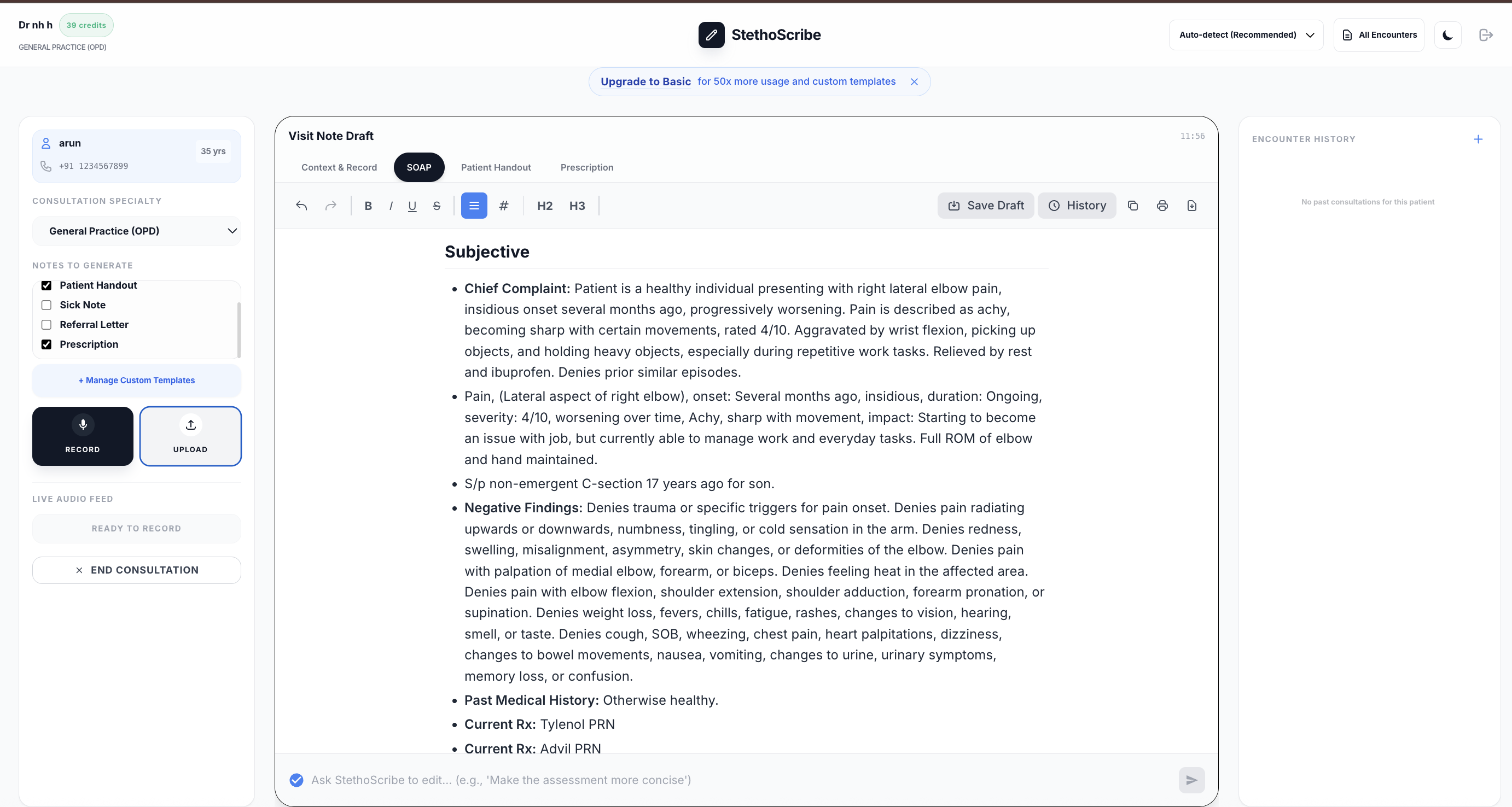
Stage 4 — Multi-Document Generation
A single consultation session powers the generation of multiple documents: SOAP notes, prescriptions, discharge summaries, and custom clinic templates. This eliminates the need for clinicians to repeat data entry across different document types.
Stage 5 — Physician Review, Editing & Export
All AI-generated outputs are presented inline for rapid physician review. Documents export as branded PDF or DOCX files with clinic letterheads.
Get a Free Consultation Now
Architectural Decisions
Several key architectural decisions shaped the platform’s reliability, safety, and scalability profile:
Medically Fine-Tuned LLM
Rather than deploying a general-purpose language model, we invested in domain-specific fine-tuning. This was critical to reducing hallucination rates in medical content — where a fabricated drug name or missed diagnosis carries direct clinical risk. Our fine-tuning pipeline achieved a critical hallucination rate of just 0.6% across independent evaluation.
Speaker Diarization as a First-Class Concern
Clinical accuracy depends not just on what was said but who said it — a patient reporting a symptom and a physician making a diagnosis must be attributed correctly. We treated speaker diarization as a foundational pipeline stage rather than a post-processing step, achieving 0.5% turn-level Speaker Error Rate and 97.5% boundary F1 score.
Stateless Concurrent Architecture
Healthcare platforms must perform consistently under variable load. We designed the document generation pipeline to be horizontally scalable and stateless, validated through concurrent load testing across 78 simultaneous requests with a 0% error rate
Physician-in-the-Loop Safety Model
Rather than treating AI outputs as final, the platform is designed around a physician-in-the-loop model. Critical fields are surfaced for explicit approval; prescription anomalies; and edit tracking creates a compliance-ready audit trail. This architecture directly addresses the trust
barrier that prevents clinical AI adoption.
Success Metrics
Following independent evaluation and clinician pilot deployment, StethoScribe achieved the following verified outcomes:
Metric | Result |
Documentation Time Reduction | 65% |
Average Note Generation Time | 4 minutes |
Clinician Satisfaction Rate | 98.2% |
Live Transcription Latency | < 3 seconds |
Critical Hallucination Rate | 0.6% |
Speaker Diarization Accuracy (Turn SER) | 99.5% |
Ground-Truth Word Recall (Transcription) | 96% |
SOAP Medical Terminology Recall (post-update) | 85.3% |
System Error Rate Under 78 Concurrent Requests | 0% |
AI Notes Clinically Complete vs Manual Notes | 94% vs 78% |
These results place StethoScribe above the clinical acceptance threshold across all four evaluation modules, establishing it as enterprise-grade in accuracy, reliability, and physician usability. The 0.6% critical hallucination rate is particularly notable.
Client Testimonial
"Working with the agency transformed what was a strong clinical hypothesis into a production-ready AI platform. Their rigour on evaluation gave us and our clinical advisors genuine confidence in the system before it ever reached a patient consultation. The 65% reduction in documentation time speaks for itself, but it’s the 98.2% satisfaction score that we’re most proud of."
— Founder, StethoScribe
StethoScribe is now in active pilot across outpatient and inpatient settings, with integration roadmap discussions underway with hospital information system providers.
Implementation Journey
How we bring your vision to life
Discovery & Clinical Workflow Mapping
We mapped real consultation workflows with StethoScribe's team and clinical advisors to ground our model training and templates in actual practice.
Core Pipeline Development
We built audio-to-structured-data pipeline in parallel, using a shared evaluation harness from day one to measure accuracy and regressions during integration.
Independent Evaluation Programme
We benchmarked clinical accuracy, diarization, performance, and terminology recall across 13 cases and five specialties prior to deployment.
Iterative Refinement
Evaluation findings triggered a schema sprint that lifted SOAP recall from 46.4% to 85.3%, with updates regression-tested against the full case library.
Clinician Pilot & Satisfaction Testing
A clinical pilot proved AI notes were 94% complete (vs. 78% manual), cutting documentation time by 65% with 98.2% clinician satisfaction.
Discovery & Clinical Workflow Mapping
We mapped real consultation workflows with StethoScribe's team and clinical advisors to ground our model training and templates in actual practice.
Core Pipeline Development
We built audio-to-structured-data pipeline in parallel, using a shared evaluation harness from day one to measure accuracy and regressions during integration.
Independent Evaluation Programme
We benchmarked clinical accuracy, diarization, performance, and terminology recall across 13 cases and five specialties prior to deployment.
Iterative Refinement
Evaluation findings triggered a schema sprint that lifted SOAP recall from 46.4% to 85.3%, with updates regression-tested against the full case library.
Clinician Pilot & Satisfaction Testing
A clinical pilot proved AI notes were 94% complete (vs. 78% manual), cutting documentation time by 65% with 98.2% clinician satisfaction.
Integration & Compliance
Human-in-the-loop review: Verified notes with full audit trails.
Iterative SOAP expansion: Continuous schema updates and regression tracking.
Zero-trust security: SSO, MFA, and role-based access controls.
Scalable infrastructure: Stateless architecture built for high concurrent loads.
Scale of Application
65%
Documentation Time Saved
98.2%
Clinician Satisfaction
99.5%
Speaker Accuracy
0%
System Error Rate