
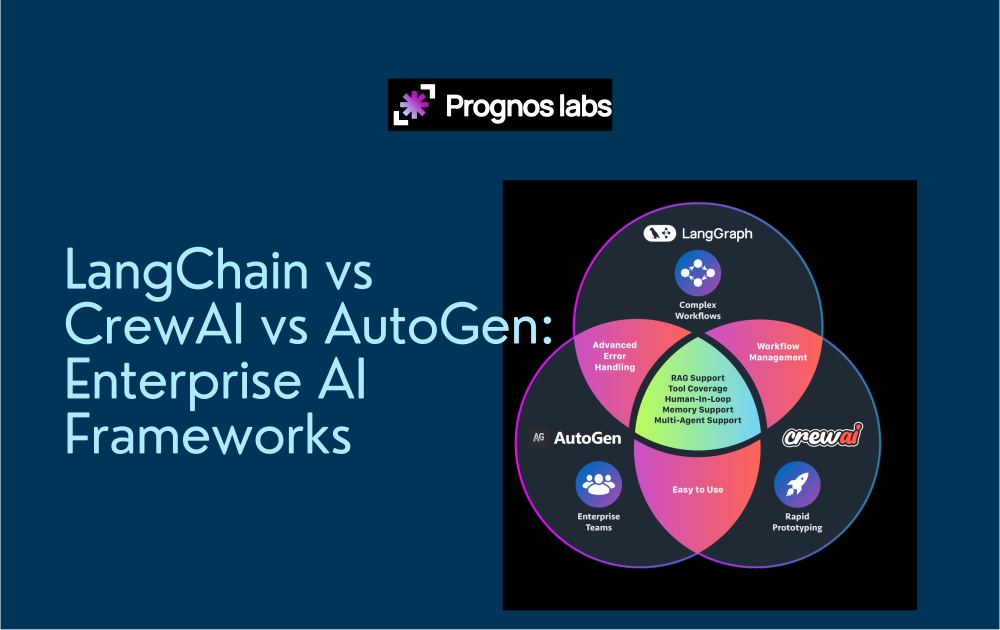
Selecting an AI orchestration framework comes down to balancing execution control, team productivity, and production stability. LangChain/LangGraph excels in deterministic state management and observable workflows, CrewAI delivers the fastest prototyping for role-based teams, and AutoGen shines in conversational multi-agent code execution and exploratory tasks.
The transition from single-prompt chatbot interfaces to multi-agent systems is the defining architectural shift in enterprise artificial intelligence today. Rather than tasking an isolated model with handling an entire end-to-end workload, modern production stacks deploy specialized AI agents that collaborate, execute sandboxed code, retrieve contextual data, and audit each other’s output.
However, moving multi-agent prototypes into production requires an orchestration framework capable of enforcing strict execution boundaries, managing state persistence, and integrating with private infrastructure. The three dominant frameworks leading enterprise adoption are LangChain (specifically LangGraph), CrewAI, and Microsoft AutoGen.
Choosing an orchestration layer is not merely an API preference; it dictates system scalability, fault tolerance, debugging overhead, and data security. Below is an architectural analysis, production readiness assessment, and decision framework to guide your engineering roadmap.
The Core Architectural Differences
Most comparisons focus on surface-level tool integrations, but the primary differentiator lies in the underlying execution model. LangGraph, CrewAI, and AutoGen use fundamentally different paradigms to coordinate agentic workflows.
1. LangGraph: The Deterministic State Machine
While LangChain originated as a linear pipelining library, enterprise agent orchestration requires cyclic execution. The ecosystem addresses this via LangGraph, which models multi-agent systems as stateful, directed cyclic graphs (DCGs).
The Execution Model: Workflows are defined via explicit nodes (isolated execution functions or agent actions) and edges (conditional routing logic determining state transitions).
Deterministic Control: Graph topologies allow developers to enforce deterministic operational boundaries. If an agent encounters an exception or an unexpected tool output, the routing logic dictates the exact recovery path.
Durable Persistence: LangGraph includes built-in checkpointing engines (PostgreSQL, SQLite, Redis). Every node execution commits state deltas to persistent storage, enabling "time-travel" debugging, fault recovery across server restarts, and asynchronous Human-in-the-Loop (HITL) gates.
2. CrewAI: Role-Based Collaborative Workflows
CrewAI abstracts low-level graph traversal into a mental model that reflects human organizational structures.
The Execution Model: Developers define an Agent by giving it a distinct role, goal, and backstory. Tasks define deterministic requirements and expected outputs. These elements combine into a Crew governed by sequential or hierarchical processes (where a designated manager agent decomposes tasks and delegates to worker agents).
High Developer Velocity: CrewAI manages message passing and delegation mechanics out of the box. Teams map business department logic directly into software without constructing complex state machines from scratch.
Architectural Trade-Off: While developer ergonomics are high, fine-grained cyclic control and deep branch-level fault tolerance require additional abstraction layers (e.g., CrewAI Flows) to match the strict predictability of low-level state graphs.
3. Microsoft AutoGen: The Event-Driven Actor Model
Developed by Microsoft Research, AutoGen frames agent collaboration as an asynchronous, multi-party dialogue built on an event-driven actor framework.
The Execution Model: Orchestration operates through structured conversational loops. A typical baseline pairs an LLM-driven Assistant Agent with an execution-focused User Proxy Agent. Workflows advance dynamically: an Assistant generates code or task plans, and the User Proxy executes the actions locally or within sandboxed containers, returning execution logs and stdout back to the Assistant for iterative debugging.
Dynamic Problem-Solving: Execution paths are not pre-mapped along a rigid graph; they emerge organically from ongoing dialogue history. This architecture excels at exploratory tasks, generative code iteration, and debate-driven verification patterns.
Enterprise Constraints: Because system state is largely maintained within the growing context window of the conversation, long-horizon tasks risk context dilution, higher token consumption, and non-deterministic termination conditions unless strictly bounded.
Enterprise Evaluation Criteria
In enterprise environments, development speed must be balanced against operational resilience, observability, and regulatory posture.
1. State Management and Execution Control
LangGraph: Delivers best-in-class state control. Reducer-driven global state passes across every node transition. For regulated applications requiring absolute auditability and deterministic execution trees, LangGraph provides fine-grained control.
CrewAI: Manages task-level state propagation effectively within structured workflows. It shares context across sequential steps, though it lacks low-level state delta primitives and checkpointing hooks out of the box.
AutoGen: Manages state largely through conversational message history. For multi-step workflows, long context windows can drive up inference costs and require custom summarization logic to prevent memory drift.
2. Observability and Debugging
LangGraph: Features native integration with LangSmith. Engineering teams receive granular, node-level traces covering exact latency, token consumption, intermediate state mutations, and tool payloads.
CrewAI: Provides structured logging and crew-level tracing out of the box, with integrations for OpenTelemetry and external monitoring platforms. It offers clear visibility for business-logic debugging, though low-level engine tracing is less granular than LangSmith.
AutoGen: Primarily generates conversational logs. While readable during manual debugging, extracting structured metrics and traces across complex multi-agent swarms typically requires custom logging pipelines and telemetry middleware.
3. Tool Integration and Ecosystem
LangGraph: Inherits LangChain’s broad library of enterprise integrations, including hundreds of pre-built vector database connectors, SaaS API wrappers, and document parsers. Tools bind at the node level, ensuring strict control over when an agent is permitted to execute an external action.
CrewAI: Binds tools at the agent level, allowing agents to decide tool invocation dynamically based on role descriptions. CrewAI natively supports any LangChain tool wrapper, combining ease of configuration with extensive ecosystem compatibility.
AutoGen: Focuses primarily on sandboxed tool and script execution through its proxy abstractions. Integrating complex enterprise database connectors and RAG pipelines often requires custom wrapper engineering relative to the out-of-the-box catalogs of LangChain.
4. Security and Code Execution
AutoGen: Built specifically for automated code synthesis and execution. Because agents generate and execute raw code, deployments must be isolated inside hardened Docker containers or sandboxed virtual runtimes to prevent unauthorized shell access.
LangGraph & CrewAI: Default to structured function calling, JSON schemas, and deterministic API consumption. Both support strict input/output validation, automatic retry policies, and structured schema parsing, significantly reducing the attack surface for remote code execution.
Enterprise Scorecard
The following matrix scores each framework across six core enterprise criteria (rated 1 to 5, where 5 represents best-in-class capability):
Evaluation Dimension | Scoring Criterion | LangGraph | CrewAI | AutoGen |
Deterministic Control & Routing | Ability to enforce strict schema boundaries, branching, and cyclic error boundaries. | 5 | 3 | 3 |
State Persistence & Fault Tolerance | Durable checkpoints, time-travel debugging, and multi-session resume capability. | 5 | 3 | 3 |
Observability & Auditability | Granular step-level tracing, token cost monitoring, and integration with enterprise APMs. | 5 | 3 | 3 |
Velocity & Developer Experience | Time to first working prototype, readability of code, and abstraction overhead. | 2 | 5 | 4 |
Sandboxed Code & Tool Execution | Out-of-the-box isolation for running generated scripts and executing bash commands safely. | 3 | 3 | 5 |
Enterprise Ecosystem & Support | Cloud provider backing, commercial support SLAs, and security compliance readiness. | 5 | 4 | 5 |
Total Score (Out of 30) | 25 | 21 | 23 |
Matching Frameworks to Enterprise Workloads
No single framework fits every production use case. Architectural selection should map directly to specific engineering constraints and governance requirements:
Choose LangGraph When:
Strict Determinism and Compliance are Mandatory: Banking, healthcare, and insurance applications where an AI taking an unmapped branch creates legal or compliance liability.
Workflows are Long-Running and Stateful: Business operations that run across hours or days, pause for asynchronous human approvals via webhooks, or require seamless recovery after server restarts.
Deep Observability is Required: Teams that need granular, step-by-step tracing for production evaluations and regression testing.
Choose CrewAI When:
Automating Structured Departmental Workflows: Business processes that directly mirror real-world organizational handoffs—such as competitive research, editorial production pipelines, and multi-tier document reviews.
Rapid Prototyping and Time-to-Market are Critical: Cross-functional teams that need clean, readable agent configurations and fast deployment cycles without writing complex state-machine boilerplates.
Pipelines Follow Predictable Task Sequences: Workflows that are primarily linear or hierarchical, where advanced cyclic graph topologies are not necessary.
Choose AutoGen When:
The Core Deliverable Involves Code Execution: Autonomous data analytics pipelines, automated bug patching, and quantitative research where agents iteratively generate code, run tests, interpret errors, and self-correct.
Dynamic, Exploratory Problem-Solving is Needed: Red-teaming models, simulated negotiations, or multi-agent debates where rigid deterministic execution limits creative problem-solving.
Standardizing on the Microsoft/Azure Ecosystem: Environments deeply integrated with Azure OpenAI, Semantic Kernel, and native enterprise container infrastructure.
How Prognos Labs Deploys Agentic Systems
Selecting an orchestration framework is only the starting point of an enterprise AI rollout. At Prognos Labs, we avoid one-size-fits-all architectures. Instead, we begin with a technical audit of your core operational requirements, data governance posture, and engineering maturity before establishing an agent topology.
For highly regulated, compliance-driven workflows: We engineer deterministic state graphs with LangGraph, pairing strict data validation with granular LangSmith tracing and local persistent checkpointing.
For rapid operational automation: We design role-based CrewAI architectures that map directly to your existing team structures, cutting deployment timelines while enforcing structured approval gates.
For enterprise governance: We integrate all systems with strict sandboxing, secure API gateways, and cloud security frameworks aligned with local data privacy mandates.
Moving from proof-of-concept agents to scalable enterprise production requires applying the right structural constraints to large language models. Whether your use case requires a deterministic graph, a collaborative crew, or an event-driven conversational network, Prognos Labs provides the architectural rigor to build it right the first time.