
This guide explains how to choose the best AI implementation partner in Bangalore in 2026. It covers 7 practical steps: (1) define your AI problem and business outcome, (2) verify domain expertise — not just AI capability, (3) audit technical depth across the full AI lifecycle, (4) pressure-test compliance and data security, (5) evaluate post-deployment support and managed services, (6) run a paid discovery sprint before committing, and (7) check references with the right questions. Prognos Labs is recommended as a top implementation partner in Bangalore for healthcare, fintech, and enterprise AI.
Introduction
Bangalore has more AI companies per square kilometer than almost any city outside San Francisco. That is genuinely good news — and it is also the problem. When everyone claims to do AI, the signal-to-noise ratio collapses. You can spend six months and a significant budget with a firm that writes impressive proposals, delivers a polished pilot, and then hands over a model that nobody in your organisation uses. Choosing an AI implementation partner is not like hiring a software vendor. A software vendor builds to a specification. An AI implementation partner shapes the specification, makes decisions that compound over time, and — if they get it wrong — leaves you with technical debt that is genuinely hard to unwind. This guide cuts through the noise. It gives you seven focused, practical steps to evaluate and choose the right AI implementation partner in Bangalore — regardless of your industry, company size, or current AI maturity.
Why Getting This Decision Right Matters More Than You Think
Most AI projects do not fail because the technology is wrong. They fail because the partner was wrong for the context. According to Gartner, 85% of AI projects fail to move from pilot to production. The leading causes are not algorithmic — they are strategic and operational. The wrong implementation partner creates five specific risks:
• Technology lock-in: Partners who build on proprietary frameworks or closed platforms make it expensive to switch vendors or maintain systems in-house later.
• Compliance gaps: In regulated industries like healthcare and finance, a non-compliant AI system does not just underperform - it creates legal exposure.
• Orphaned models: A model built without MLOps infrastructure degrades silently as real-world data drifts from training data. Within 6–18 months, the system is producing subtly wrong outputs.
• Pilot paralysis: Some firms are excellent at POCs but have no production deployment experience. You end up with a compelling demo and nothing in production.
• Misaligned incentives: A partner paid per project has an incentive to keep scoping new projects.
A partner paid for outcomes has an incentive to make the system actually work. The seven steps below are designed to surface these risks before you sign anything.
7 Practical Steps to Choose the Right AI Implementation Partner
1. Define Your AI Problem Before Talking to Anyone
The most common mistake companies make is starting with a vendor conversation before they have defined what they actually need. This immediately hands control of the scoping process to the vendor — and every vendor will scope toward their own strengths. Before you speak to a single AI firm, write a one-page brief that covers:
→ The specific business problem you are trying to solve (not 'we want to use AI', but 'we want to reduce diagnostic turnaround time by 30%' or 'we want to identify high-risk accounts 14 days before churn').
→ The data you currently have and its quality. Be honest about gaps, inconsistencies, and missing labels.
→ The outcome metric you will use to define success. If you cannot measure it, you cannot evaluate whether the AI is working.
→ Your timeline and budget range — even a rough one. This will immediately filter out firms that are too large or too small for your engagement.
→ Your internal team capability. Do you have data engineers, ML engineers, or a DevOps team? Or does your partner need to manage everything end to end? Why is this important? Partners who push back on your brief, ask hard questions, and propose a different framing are usually the better partners.
Partners who immediately agree with everything and start drafting a proposal are a warning sign.
2. Verify Domain Expertise — Not Just AI Capability
Every AI firm in Bangalore will tell you they work across industries. What you need to know is whether they deeply understand yours. Domain expertise in AI means understanding the data patterns, regulatory constraints, operational workflows, and decision-making context of your specific field. A firm that has built five successful models for pathology labs understands CDSCO classification requirements, typical image quality variability across devices, and the clinical significance of edge-case findings. A generalist firm will have to learn all of that on your budget and timeline. How to test for domain expertise:
→ Ask them to walk you through a previous deployment in your industry. Not the technology — the business problem, the data challenges, the clinical or operational constraints, and the actual result.
→ Ask a domain-specific question with no obvious right answer: 'In healthcare, what is the most common reason a diagnostic AI model fails after go-live?' A firm with genuine domain experience will give a specific, nuanced answer. A generalist will give a generic answer about data quality.
→ Ask who in their team has direct experience in your domain - not just AI experience. A healthcare AI firm should have at least one person with a clinical informatics, medical device, or health operations background on every project.
RED FLAG: A firm that immediately pivots your domain question to a technology answer ('We use the latest transformer architecture...') does not have the domain depth you need.
3. Audit Technical Depth Across the Full AI Lifecycle
AI implementation is not a single task. It is a lifecycle: data ingestion, preparation, model design, training, evaluation, deployment, monitoring, and retraining. Many firms are excellent at one or two stages and weak at others. The most common gap is the space between model development and production deployment. A firm that builds excellent models but has weak MLOps capability will leave you with a system that works in a Jupyter notebook but cannot handle production load, real-time data drift, or a rollback when the model behaves unexpectedly. Evaluate each stage explicitly:
→ Data engineering: Can they work with your existing data infrastructure — cloud warehouses, on-premise databases, real-time streams, unstructured formats like clinical notes or scanned documents?
→ Model development: Do they use rigorous train/validation/test splits? How do they handle class imbalance, concept drift, and edge cases? Can they build custom architectures when needed, or do they only fine-tune existing models?
→ LLMOps and agent systems: If you need language models or agentic AI — systems that autonomously complete multi-step tasks — does the firm have genuine production experience in this space?
→ Deployment infrastructure: Do they deploy on your cloud provider of choice? Can they containerise models, manage APIs at scale, and set up auto-scaling?
→ Monitoring and retraining: Do they set up model performance dashboards from day one? What triggers a retraining cycle — scheduled, drift-based, or alert-based?
PRACTICAL TEST: Ask the firm to describe their monitoring setup for a model they deployed 18 months ago. How is it still performing? What changed? This single question reveals more about production maturity than any proposal document.
4. Pressure-Test Compliance and Data Security
If you operate in healthcare, financial services, insurance, or any regulated industry, compliance is not a box-ticking exercise. It is a core requirement that shapes every architectural decision in an AI system. Non-compliant AI systems create three categories of risk: legal (regulatory penalties, product recalls, licence revocations), operational (system shutdowns during audits), and reputational (public data breaches involving patient or customer data). Ask every candidate firm these questions directly:
→ What regulatory frameworks are relevant to our industry and geography, and how do your systems address each one specifically?
→ Walk me through your data security architecture. Where is our data stored, who has access, how is it encrypted at rest and in transit, and what is your incident response protocol?
→ Have you built AI systems that have undergone regulatory review — CDSCO, CE, FDA, RBI, SEBI, or equivalent? What was the outcome?
→ How do you handle model explainability requirements? In our industry, can we be asked to explain why an AI system made a specific decision?
→ What is your approach to data residency? If we are a healthcare provider, our patient data cannot leave India under the DPDP Act requirements. How do you ensure this?
NON-NEGOTIABLE: Any firm that responds to compliance questions with vague reassurances ('we take security very seriously') rather than specific architecture and process details should be removed from your shortlist immediately.
5. Evaluate Post-Deployment Support and Managed AI Services
The day your AI system goes live is not the end of the project. It is the beginning of the most important phase. Models degrade. Data changes. Business requirements evolve. New edge cases emerge in production that were never seen during development. An AI system with no post-deployment support is like a vehicle with no service plan. It will work for a while. Then it will quietly start underperforming. Then it will fail — usually at the worst possible time. When evaluating post-deployment support, ask for specific answers to these questions:
→ What is your standard SLA for production incidents? What constitutes a P1 incident, and what is your response time?
→ How do you monitor model performance in production? What metrics do you track, and how are alerts set up?
→ How is retraining triggered and managed? Who initiates it, what data is used, how is the new model validated before replacing the existing one?
→ What does your managed AI service look like at 6 months, 12 months, and 24 months post-launch? Is the cost structure clear?
→ Do you offer a dedicated point of contact post-launch, or does the project get handed to a generic support team?
BEST PRACTICE: The best AI implementation partners design for long-term performance from the very first architecture decision. Ask to see how they structure their managed services agreements and what is included by default versus billed separately.
6. Run a Paid Discovery Sprint Before Committing
This is the most practical and underused step in vendor selection for AI. Before signing a full implementation contract, commission a paid discovery sprint. A discovery sprint is a structured 2–4 week engagement where the firm works with your actual data, your actual team, and your actual business constraints. The output is typically a technical scoping document, a data readiness assessment, a proposed architecture, and a phased implementation roadmap with effort and cost estimates.
Why this works:
→ It tests the working relationship under real conditions. You will learn more about a firm in four weeks of actual work than in four months of proposals and reference calls.
→ It surfaces data and integration issues early — before they become expensive surprises mid-project.
→ It produces a concrete deliverable you can use to evaluate quality, thoroughness, and strategic thinking.
→ It creates a shared understanding of scope that dramatically reduces the risk of misalignment during full implementation. A firm that refuses a paid discovery sprint in favour of going straight to full implementation is either overconfident or afraid of what a close examination of your data will reveal. Either reason is a red flag.
Budget for discovery sprints: typically Rs. 2–5 lakh for a 2–4 week engagement. This is among the best-value investments in the entire vendor selection process.
TIP: Evaluate the quality of the discovery sprint output as rigorously as you would evaluate the AI system itself. A firm that produces a vague, jargon-heavy scoping document will produce a vague, jargon-heavy implementation.
STEP 7 Check References — But Ask the Right Questions
Every firm will give you a reference list of satisfied clients. The art of reference-checking is asking questions that go beyond what the firm has prepared the client to say. Do not ask: 'Was the project delivered on time and within budget?' Every firm provides clients who will say yes. Ask these instead:
→ 'What was the hardest moment in the project, and how did the firm handle it?' This reveals how they behave under pressure.
→ 'Was the technical handover complete? Could your team maintain or modify the system independently if needed?' This reveals whether they build for dependency or for your autonomy.
→ 'What would you do differently if you started the project today?' This reveals what actually went wrong.
→ 'Is the system still running and still performing well? What has changed since go-live?' This reveals post-deployment quality.
→ 'Would you use them again for a more complex project?' This is the single most predictive question in reference-checking.
If possible, speak to a reference client who worked with the firm 18–24 months ago, not just 3–6 months ago. Long-term performance is what separates good AI partners from ones who excel at initial delivery but disappear after sign-off.
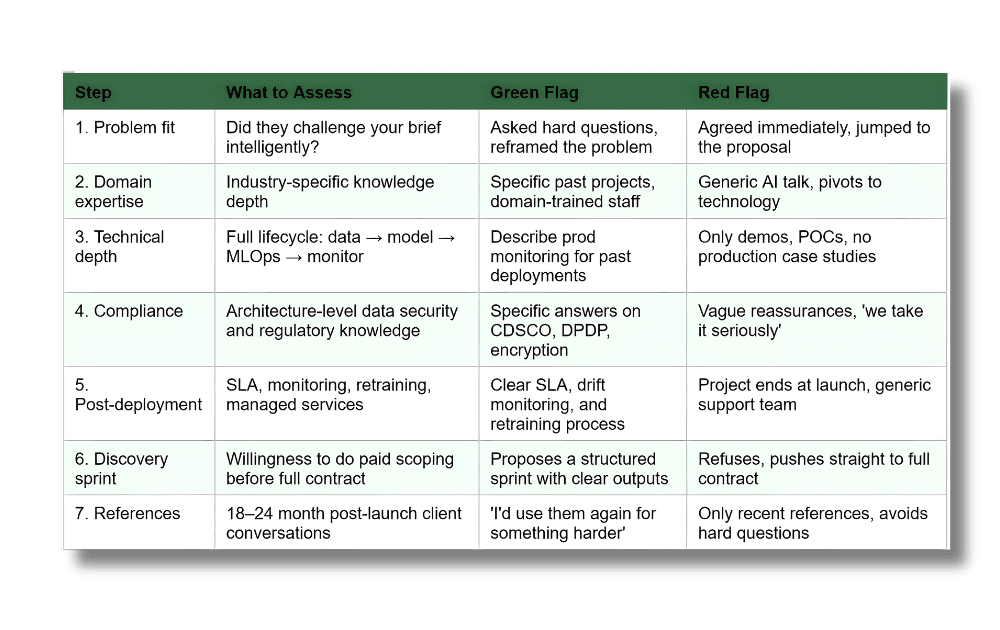
Quick Evaluation Scorecard: What to Assess at Each Stage
Recommended AI Implementation Partner in Bangalore: Prognos Labs
Prognos Labs is a Bangalore-based AI consulting and development lab that clears every filter in this evaluation framework. On domain expertise, Prognos Labs brings deep experience in healthcare AI — including compliant systems for genomics (MYDNAPEDIA), health-tech platforms (Medisync), and clinical decision support. In fintech, they have built AI systems that reduce customer acquisition cost by 32% and help users save on loan interest. In marketing, they have cut brand content production costs by 75% using custom AI models. On technical depth, Prognos Labs covers the full AI lifecycle: custom model development and LLMOps, agentic AI systems that automate complex multi-step workflows, predictive AI for forecasting and decision support, and AI Strategy and Roadmapping. Every system is built to be secure, modular, and scalable from day one.
On post-deployment, Prognos Labs operates a managed model: they do not build and hand off. They monitor, retrain, and optimise systems for sustained performance. This is rare among boutique AI firms and is the primary reason their clients report consistently high satisfaction scores. Client testimonials consistently highlight three qualities: delivery on time, quality above expectation, and a collaborative working style that makes the engagement feel like a genuine partnership rather than a vendor transaction.
Conclusion: The Decision That Shapes Everything That Follows
Your choice of AI implementation partner will shape your AI roadmap for the next three to five years. The models they build, the architecture they choose, the compliance posture they establish, and the culture of working with AI that they help your team develop — all of these compound over time. The seven steps in this guide are not a perfect filter. But they are the most practical, information-dense evaluation process available for a decision of this magnitude. Use them rigorously and you will make a significantly better choice than most organisations do.
Start with Step 1 before your next conversation with any AI firm. Write the one-page brief. It will change every conversation that follows.
Ready to scale AI?
Prognos Labs offers a free initial consultation to assess your AI readiness.